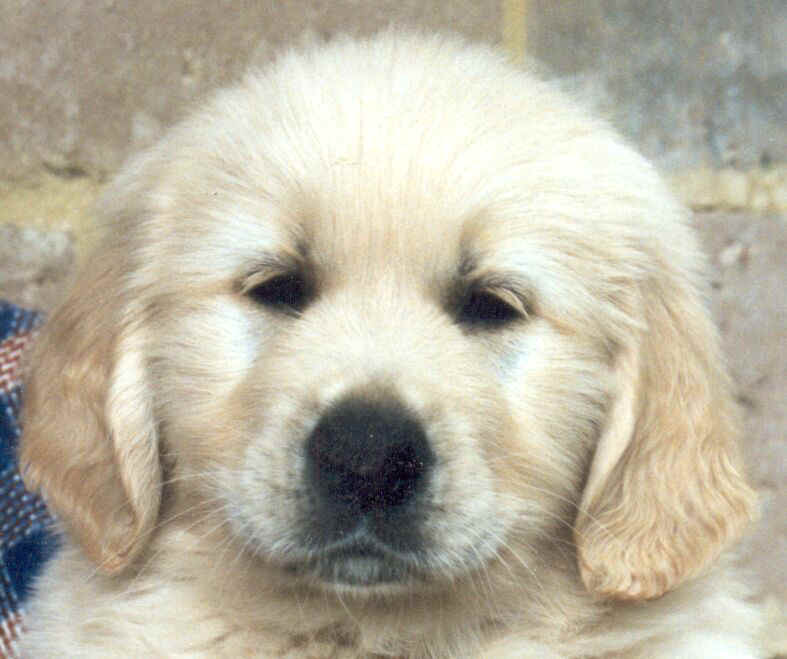
Alnclair Golden Retrievers
Breed History
The History of the Golden Retriever (Information courtesy of the UK Golden Retriever Council)
Unlike many breeds, the development of the Golden Retriever in historical terms is fairly recent, and thanks to the painstaking research carried out by breed historians, firstly the late Elma Stonex, and latterly Val Foss and Frank and Anne Weekes, the history is quite defined and documented.
The breed originated from a series of matings carried out by Lord Tweedmouth from 1864 onwards. The starting point was his acquisition of a good looking yellow coloured Flat Coated Retriever which he took to his estate at Guisechan, near Inverness in Scotland. He mated this dog to a Tweed Water Spaniel, a breed now long extinct, and then bred on from the offspring of this mating using the occasional outcross to an Irish Setter, a second Tweed Water Spaniel and a black Flat Coated Retriever. The dogs produced proved to be grand workers, biddable and attractive. Puppies from the matings were given to friends and family, notably his nephew, Lord Ilchester, who also bred them. The dogs bred true to type, and so the forerunners of the breed we know today were established.
It was not until 1908 that the breed came into the public eye. Lord Harcourt had formed a great liking for the breed, and had gathered on to his estate at Nuneham Park, Oxford, a collection of the dogs descended from the original matings. He decided to exhibit them at the Kennel Club Show in 1908, where they created great interest. They were entered in a class for Any Variety Retriever, and described as Yellow Flatcoated Retrievers. The term 'Golden Retriever' was first coined around this time, and has been attributed to Lord Harcourt.
Once they had been seen by the general public, there were many people that wanted to own one for them selves, and the breeds popularity was assured. One of the people that saw them and acquired one for herself was Mrs Charlesworth, who became the greatest enthusiast the breed has ever had. From 1910 when she acquired her first Golden, until her death in 1954, she championed the cause of the breed against allcomers, and nagged her fellow enthusiasts remorselessly to keep the breed as a true dual purpose dog. She, it was who organised her fellow enthusiasts into forming a Golden Retriever Club in 1911, writing a breed standard, and campaigning for the breed to be registered with the Kennel Club as a separate breed. (The Kennel Club had previously registered them as Flatcoated Retrievers). The breed was accepted by the Kennel Club in 1913, and an allocation of Challenge Certificates was made the same year. The race had already been on to see who could win the first Field Trial award with a Golden, and the honour had fallen in 1912 to Captain Hardy with his bitch Vixie, who went on to become an influential dam in the breed. The honour of winning the first C.C.'s on offer proved to be an anti-climax.
One enthusiast, Col Le Poer Trench, insisted that the Golden had developed from a breed found in Russia, and had persuaded the Kennel Club to register his dogs as Yellow Russian Retrievers. At Crufts Dog show in 1913, there were classes for Goldens and for Russian Retrievers, but only one set of C.c.'s The best Goldens had to challenge the best Russians for the C.c.'s, and the Russians won both of them! At the next show, however, there were Challenge Certificates exclusively for Goldens, and the honour of being the first to win a C.C. went to Mrs Charlesworth's dog Normanby Sandy and Mr F. W. Herbert's bitch Coquette. The race was then on to win 3 C.c.'s and a Field Trial award and thus become the first Golden Champion, an honour achieved by Mrs Charlesworth with her dog Noranby Campfire. All canine activities came to a halt as the First World War grew in intensity, but the Golden Retriever had done enough to establish itself in the canine world, and the hearts of the dog owning public.
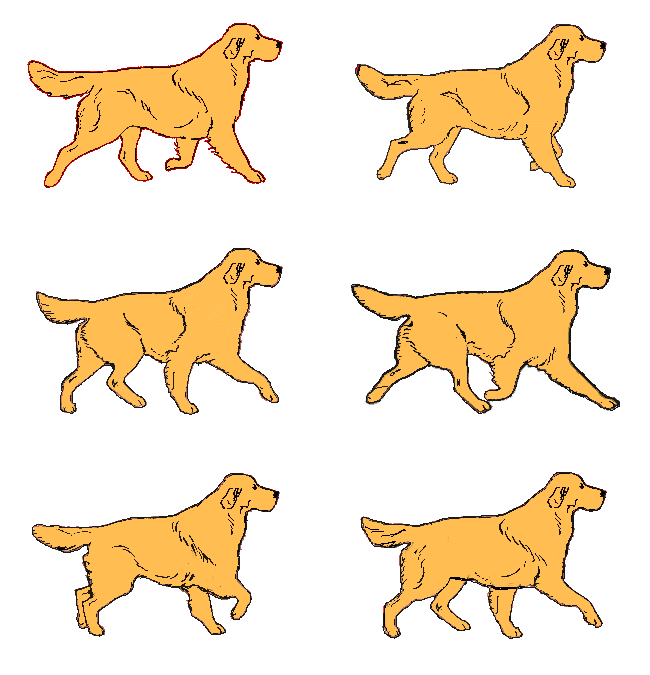
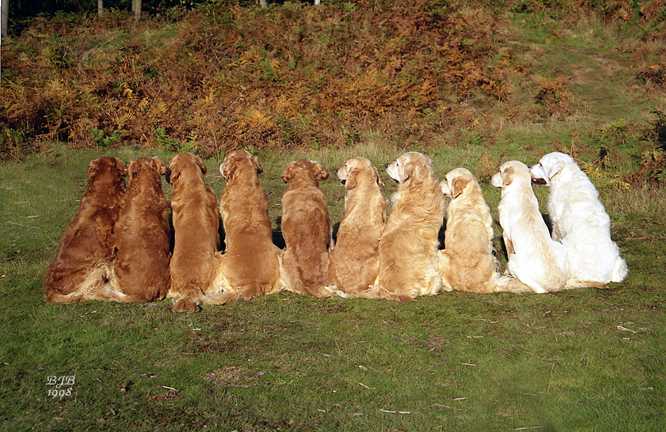
See below the full range of acceptable colours for Golden Retrievers
Photo courtesy of Brian Booth - Monbryth Golden Retrievers, Wilts, UK
Click here to read the Golden Retriever BREED STANDARD
And please click the link below to read a concise statement from the GRCA regarding the reason to breed pure-bred Golden Retrievers
https://www.grca.org/find-a-golden/more-topics-before-you-buy/goldendoodles/